A low whitewashed building with a curved roofline and tall factory windows, pines and rows of citrus trees behind it under a blue sky

Chimney repair in Winter Garden.

The work targets the parts that fail soonest: crowns, caps, flashing, mortar, firebrick and liners, preferably when the damage is still slight and before water and heat have a chance to compound it.
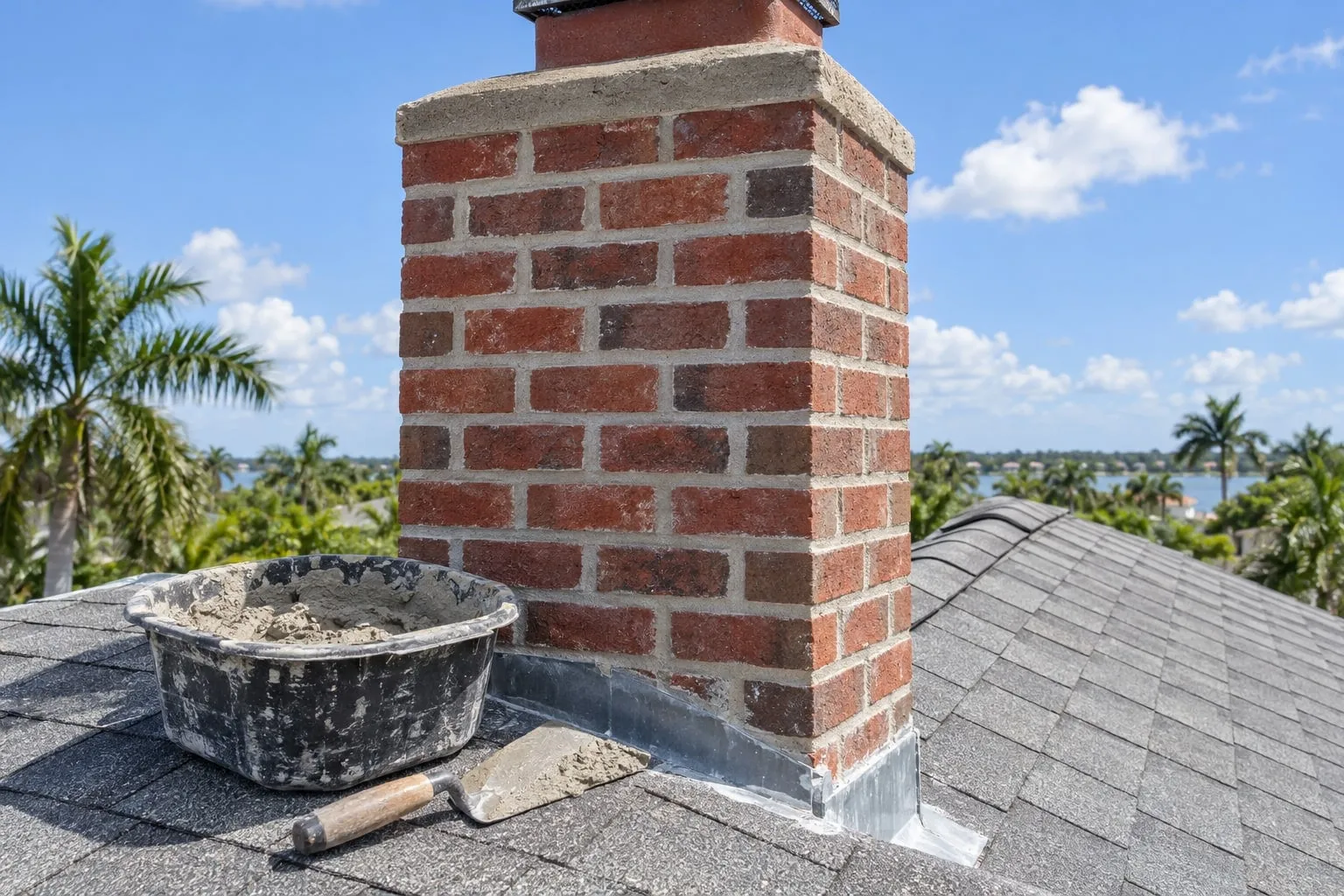
A bucket of mortar and a trowel on a grey shingle roof beside a red brick chimney with freshly repointed joints
  • Based in Winter GardenWest Orange County
  • A call backWe choose the day together
  • Request formAlways open

Repairs, from the roof down.

Each part of a chimney wears in its own way. These are the usual repairs, read against the weather of west Orange County.

  1. The crown.

    Across the top of the masonry the crown carries rain away from brick and flue. Florida's residential code wants it pitched, with an overhanging drip edge and a sealed joint around the liner (R1003.9.1), and nothing else on a chimney takes so much weather.

    Two volunteer gauges named for Winter Garden recorded 9.10 and 10.78 inches around Hurricane Ian. A thin crack can be sealed. A slab that is crumbling, or has separated from the liner, must be removed and cast new.

  2. Caps and mesh.

    The cap excludes rain, birds and squirrels from the flue, and its mesh stops sparks. On a masonry chimney, Florida's code sets the open area of any spark arrestor or rain cap at no less than four times the flue outlet's (R1003.9.2, R1003.9.3).

    Metal caps get dented in storms, shaken loose by gusts and eaten by rust. Once a storm has passed, check for dents, screws backing out, rusted seams and mesh that droops or clogs. If swifts are nesting in the flue, a new cap waits: federal law shields the birds, and the Fish and Wildlife Service wants such chimneys left open.

  3. Flashing at the joint.

    At the point where the chimney passes through the roof, flashing closes the joint. Wind-driven rain feels for a raised edge or a bead of sealant that has dried out, and the clue indoors is typically a brown stain overhead or damp insulation next to the stack.

    A chimney wider than 30 inches measured along the ridge, and not on the ridgeline itself, calls for a cricket on the uphill side with its own flashing and counterflashing (R1003.20).

  4. Brick, veneer and mortar.

    Mortar is meant to be the part that wears. Once joints open, moisture is drawn in behind the face of the brick and the surface begins to flake, which masons call spalling.

    In tuckpointing, worn mortar is ground out and the joints are filled with fresh material while the brick itself is still sound. Bricks that have cracked right through or lost deep flakes are cut out and replaced. Brick laid as a veneer over a framed chimney must have through-flashing and weep holes so that water can escape (R1003.10.1).

  5. Inside the firebox.

    Flames and heat strike firebrick and its mortar directly. Opened joints or cracked brick can let heat creep toward the timber framing behind the wall, and a small gap closed early stops that.

  6. The flue liner.

    From damper to cap the liner protects the structure of the house from smoke and heat, and the code states that masonry chimneys are to be lined (R1003.11). A tile that has cracked or slipped, or a rusted seam in a metal liner, can pass heat toward the framing or fumes toward the living space with nothing to see from roof or firebox. Only a camera sent down the flue exposes such faults, which is the purpose of a Level 2 inspection. The typical Winter Garden house dates from 2004, so its flue has about twenty-two years behind it.

  7. Metal pans and chases.

    Some chimneys are not masonry. A chase is a boxed frame finished to match the house and topped with a metal pan; if the flue inside is a factory-built one, it has to be listed and labeled (R1005.1). Should the pan rust through or sag, water pools on it and drains into the framing. A screened cap on the flue, above a pan that drains as it should, keeps the framing dry.

Request a repair visit

Questions about repairs.

Short answers, with a source where there is one.

Why do crowns crack?

Sitting at the very top, a crown gets drenched, baked and cooled again and again. When a hairline crack begins to hold water, moisture works down into the brick and the flue. Sealing it promptly keeps the repair modest, while waiting lets the crack grow.

What does a damp hearth mean?

Water at the hearth, or a stain on a ceiling nearby, usually points to an entry point above: cap, crown, flashing or tired mortar. An inspection finds the path.

How does tuckpointing work?

Tired mortar is cut back and the joint is filled again with new mortar. Joints are intended to wear before the brick does, so some loss is normal; trouble starts when they gape. Repointing while the brick is sound keeps it seated, and open joints let water behind the face.

Must a chimney have a cap?

Almost always. An open flue admits rain, birds and squirrels and does nothing to hold in sparks. A masonry chimney under the Florida code gets a cap pitched to drain (R1003.9.1), and any spark arrestor or rain cap must offer four times the flue outlet's open area.

Will I see the plan first?

Yes. The findings are explained part by part, and which repairs go ahead, and when, is for you to decide.

How do I start?

Ring (689) 303-3540, or put what you have noticed on the form below, which is open at all hours.

What made you think of the chimney?

Describe it on the form or simply ring us. A person calls you back, and you settle on a day between you.

  1. 1Get in touch Ring the number or send the short form.
  2. 2A callback We phone you and fix a date together.
  3. 3Top to bottom Each of the six parts is examined in turn.
  4. 4Your choice We explain the findings and you decide on any work.

Phone

Ring and say what is needed.

(689) 303-3540

Request form

Open day and night

What do you need?

Which service?

About your fireplace

What does it burn?

Reaching you

Best time for the call back

Back

Cooler weather coming, or a storm that may have shaken something loose?